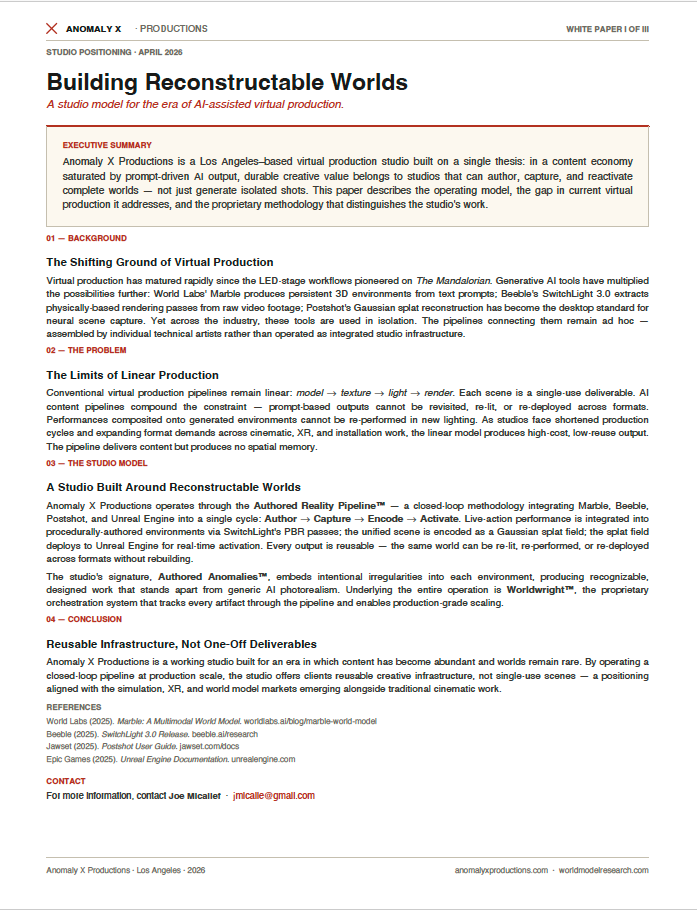
White Paper I
Studio Launch
April 2026
Anomaly X Productions launches Worldwright™
A new kind of production studio for the age of real-time, AI-assisted, world-based storytelling.
Anomaly X Productions, a Los Angeles–based virtual production studio founded by creative technologist
Joseph Micallef, today announced the launch of Worldwright™, its proprietary
orchestration system for authored virtual production. Worldwright™ powers the studio's flagship
methodology, the Authored Reality Pipeline™ (ARP) — a system that transforms
procedurally generated environments and live-action footage into reconstructable, real-time virtual
worlds.
The studio is built around a single conviction: in a landscape flooded with prompt-driven content,
the future belongs to creators who can author worlds with intent, structure, and perceptual
fidelity. Anomaly X Productions exists to build those worlds — and the systems that make them
repeatable.
"Most AI studios generate content. Anomaly X builds worlds — designed, captured, and
re-experienced. Our pipeline doesn't just make assets. It makes systems that can be revisited,
re-lit, and re-performed." — Joseph Micallef, Founder
About Anomaly X Productions
Anomaly X Productions is a creative technology studio working at the intersection of virtual
production, real-time engines, AI compositing, and Gaussian splat reconstruction. The studio designs
and deploys hybrid pipelines that bridge cinematic storytelling, immersive installation, and
simulation-based world modeling.
The "X" in the name is intentional. It marks the studio's signature methodology: Authored
Anomalies™ — the deliberate, narrative-driven irregularities embedded into every world.
Where most AI pipelines aim for generic photorealism, Anomaly X treats the anomaly as the signal.
The break in logic, the impossible shadow, the scale distortion — these are not glitches. They are
the fingerprints of authorship.
Studio Capabilities
- Virtual production and LED stage workflows
- Real-time cinematic environments
- Gaussian splat scene reconstruction and deployment
- AI-assisted live-action compositing
- Interactive installations and projection systems
- Simulation environments for AI training and research
- Creative-technical pipeline consulting
The Problem with Current Pipelines
Traditional virtual production and AI content pipelines suffer from the same fundamental constraint:
they are linear, asset-based, and built around a one-way flow of creation to render. Asset-heavy
workflows require expensive modeling for every scene variation. AI content pipelines generate output
but produce nothing reusable — every prompt is a dead end. Compositing workflows layer footage on
top of environments, never inside them. And real-time engines are treated as the place where worlds
are built, not where they are activated. The result: fragile, one-off productions
with no spatial memory and no system-level reusability. Anomaly X Productions was founded to address
this directly.
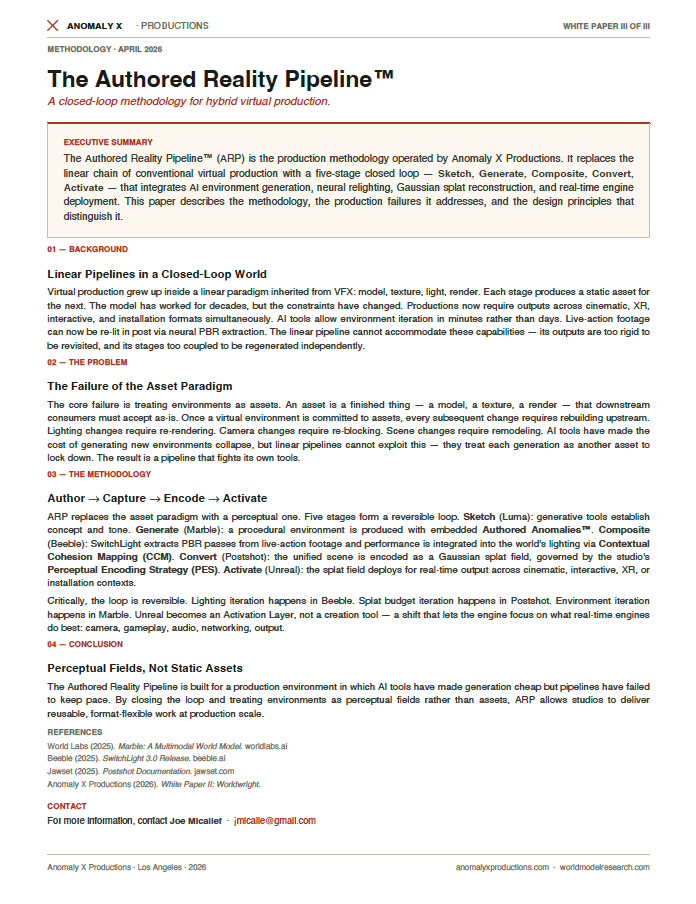
The Authored Reality Pipeline™
The Authored Reality Pipeline™ is the studio's core production methodology. It replaces the
traditional linear chain — model → texture → light → render — with a closed-loop system:
Author → Capture → Encode → Activate. Worlds are designed procedurally, intersected
with live-action performance, encoded as perceptual data via Gaussian splats, and deployed in
real-time engines as reconstructable environments.
The Five Stages
01 — Sketch · Luma's Innovative Dreams. Hybrid concepting and previs. Dream Machine
and Ray3 ideate the world's tone, motion language, and visual references before structure is
committed.
02 — Generate · Marble World Builder. Environments generated through rule-based
systems, not handcrafted geometry. Spatial logic, scale relationships, and narrative intent embedded
at the foundation. Every world receives at least one Authored Anomaly™ — a designed irregularity
that gives the environment its identity.
03 — Composite · Beeble. Live-action footage processed through Beeble's AI-driven
keying and relighting. Performers are not composited onto environments — they are
integrated into them, with lighting and color matched to the procedural world's logic.
04 — Convert · Postshot. Unified scenes converted into Gaussian splat
representations. This stage is governed by the studio's proprietary Perceptual Encoding
Strategy (PES), which prioritizes visual hierarchy, focal density, and motion
readability over raw geometric fidelity.
05 — Activate · Unreal Engine. Encoded environments deployed into Unreal for
cinematic output, interactive experience, XR delivery, or installation. Critically, Unreal is not
where worlds are built — it is where authored worlds are played back.
Worldwright™ — The Orchestration System
Worldwright™ is the proprietary orchestration system that automates and unifies the Authored Reality
Pipeline™. It is the connective tissue between every tool in the chain — and the system of record
for every world the studio produces.
It standardizes project structure across every stage, tracks assets, versions, and transformations
through the entire pipeline, automates handoffs between procedural generation, compositing, splat
conversion, and real-time deployment, encodes scenes as structured data, and maintains world memory
— every environment becomes a reusable, reconstructable system.
At its foundation is SceneDNA™, the studio's proprietary metadata and scripting
schema for describing world behavior. SceneDNA encodes environment logic (gravity, scale,
architectural rules), spatial and narrative relationships, performance layers, splat prioritization
and density mapping, real-time deployment configuration, and the Authored Anomalies registry.
"SceneDNA™ allows worlds to be described not just visually, but structurally — bridging
creative intent with computational systems."
Why Anomaly X Is Different
Artist-Engineered Worldbuilding. Most AI studios are run by either artists who
outsource the engineering or engineers who outsource the art. Anomaly X is built by a creative
technologist who codes the pipeline, authors the visual world, and has run a production studio.
Worlds as Systems, Not Assets. Where competitors deliver scenes, Anomaly X delivers
reconstructable environments. A world produced by the studio can be re-lit, re-performed,
re-explored, and re-deployed across film, XR, installation, or simulation.
Authored Anomalies as Brand Signature. The studio's commitment to designed
irregularity means its work is recognizable. In a market saturated with generic AI photorealism,
Anomaly X productions feel intentional, strange, and human-authored.
Production-Aware AI Infrastructure. The pipeline is not a demo. It is built to
support deadlines, review cycles, metadata, versioning, camera workflows, and client communication.
World Model Alignment. By encoding environments as structured perceptual data, the
studio's outputs are natively compatible with emerging AI world model paradigms — opening pathways
into simulation, training, and research markets that pure VFX studios cannot reach.
About the Founder
Joseph Micallef is a Los Angeles–based creative technologist, educator, and former
Director of Multimedia and Innovation Studio at Motorcar Parts of America. His work spans animation,
web development, virtual production, 3D and VFX (Houdini, Blender, Unreal), AI workflow design, and
emerging research in world model–based pipelines. Anomaly X Productions is the consolidation of that
practice into a studio.
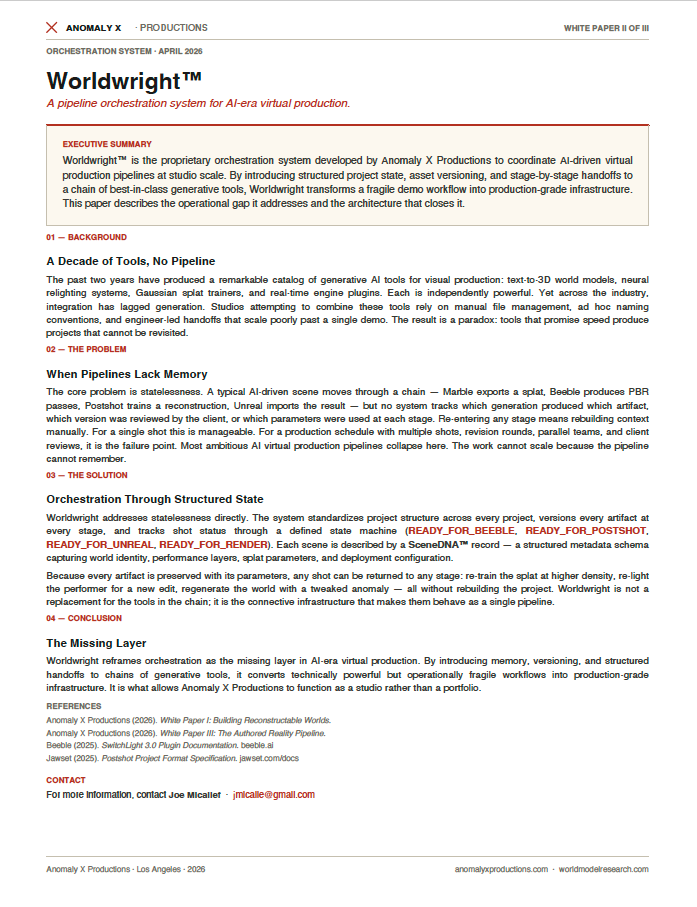
White Paper II
Software Stack
April 2026
The Authored Reality Pipeline — tool by tool.
How Marble, Beeble, Postshot, and Unreal Engine combine — under Worldwright orchestration — to
produce reconstructable virtual worlds.
Why This Stack
The Authored Reality Pipeline™ is a deliberate composition. Each of its primary tools represents the
current state of the art in its category, and each was selected for what it produces for the
next stage, not for its standalone capability. The pipeline is designed around handoffs.
Two principles guided tool selection. First, each tool must output a format that the next tool
consumes natively — no glue scripts, no manual conversion bottlenecks. Second, each tool must
support local or controlled execution. For client confidentiality, IP protection, and production
reliability, the studio prioritizes tools that can be operated on-premises or with full data
control.
Stage 02 — Marble World Builder
Vendor: World Labs (founded by Fei-Fei Li). Role: Procedural
environment generation. Output: Gaussian splats, triangle meshes, or video.
Marble is a generative multimodal world model. From a text prompt, image, video clip, panorama, or
coarse 3D layout, Marble produces a persistent, navigable 3D environment that can be explored
without the morphing or temporal inconsistency that affects frame-by-frame generative systems.
Marble 1.1 (the current release) prioritizes lighting fidelity and reduced artifacts.
Capabilities the studio uses
- Multimodal input: Text, image, multi-image (up to 8), video, panoramas, or
coarse 3D layouts via the Chisel tool, which separates structure from style.
- Persistent geometry: Worlds are stable assets, not real-time hallucinations.
They can be revisited and integrated downstream without drift.
- Editing operations: Local edits, large-scale structural changes, and the Expand
and Compose features for stitching multiple worlds into larger continuous environments.
- Export formats: Gaussian splat, triangle mesh (low-poly for physics, high-poly
for visuals), and rendered video.
The Chisel layout tool enables a critical workflow for Anomaly X: defining structural rules before
generation. This is where Authored Anomalies™ are introduced. Rather than accepting
whatever the model produces, the artist constrains the world's geometry first, then introduces a
deliberate irregularity into the structural prompt. The anomaly survives generation because it was
authored before it.
Stage 03 — Beeble (SwitchLight 3.0)
Vendor: Beeble. Role: AI-driven keying, PBR extraction, and
relighting. Output: Multi-channel 16-bit EXR with normals, base color, roughness,
metallic, specular, alpha, and depth.
Beeble's SwitchLight is a video-to-PBR neural model. SwitchLight 3.0 processes multiple frames
simultaneously for temporal stability, replacing the per-frame plus deflicker approach of version
2.0. The model is trained on roughly ten times the data of its predecessor and produces fewer
artifacts on fine detail like hair, skin, and fabric.
The studio runs Beeble Studio, the desktop version, which executes locally on GPU
hardware. This is non-negotiable for client work involving talent likeness, NDA-bound projects, or
any footage that cannot be cloud-uploaded.
Capabilities the studio uses
- Full-scene PBR generation — passes for actors, props, vehicles, architecture,
environments. Used for shots that include practical set pieces alongside performers.
- 4K, unlimited duration — up to one hour at full precision, locally on GPU.
- 16-bit EXR output — multi-channel files containing all AOV passes in a single
deliverable.
- Beeble Editor — 3D editing environment for previewing relighting in real time,
with HDRI lighting and direct import of GLTF, splats, HDRIs, and background plates.
- Render queue + native plugins for Blender, Unreal Engine, and Nuke.
The technical key here is that SwitchLight produces PBR passes, not just a keyed alpha. A performer
captured in standard studio lighting can be re-lit in post to match the warm sunset of a Marble
cathedral, the cold blue of an underwater scene, or the harsh top-down light of an authored anomaly
that violates real-world physics. The anomaly's lighting is in the world; Beeble brings the
performer into it.
Stage 04 — Postshot
Vendor: Jawset. Role: Gaussian splat reconstruction and scene
encoding. Output: PLY (Gaussian splat radiance field) and Postshot's native .psht.
Postshot is a desktop application for Gaussian splat reconstruction — now considered the leading
desktop platform in its category. It accepts photographs, image sequences, or video, performs camera
tracking and alignment, and trains splat representations of the captured scene.
Capabilities the studio uses
- Multiple training profiles — Splat3 (default, fine-detail focus), Splat MCMC
(more forgiving on imperfect captures), and Splat ADC (legacy growth-rate-controlled).
- Splat count control — hard limits on Gaussian primitives, allowing the studio
to tune for memory, render performance, and detail level. Essential for Unreal deployment.
- Live training preview — quality monitored in real time, parameters adjustable
mid-run.
- RealityCapture import — alignment data from RealityCapture produces faster and
more reliable poses than Postshot's built-in tracking. Studio standard for capture-heavy shots.
- Sky model — projects environment data onto a sphere, reducing the
floating-cloud artifacts that plague outdoor splat reconstructions.
- Region-of-interest learning, masking, editing — cleanup tools for artifact
removal and focal prioritization.
Postshot is where the pipeline performs its Perceptual Translation. The studio's
Perceptual Encoding Strategy (PES) governs this stage — specifying density priority
for narrative focal zones (faces, anomalies, hero objects), splat count budgets matched to the
target Unreal deployment, profile selection based on capture quality, sky model usage, and region
masking. PES is the difference between running a tool and operating it with intent.
Stage 05 — Unreal Engine
Vendor: Epic Games. Role: Real-time activation, camera control,
interaction, and final output.
Unreal Engine is the de facto standard for virtual production. The studio uses Unreal for Gaussian
splat rendering (via XVERSE 3D-GS, Postshot's plugin, and evolving native support), real-time camera
systems for previs and final-pixel work, Sequencer and Movie Render Queue for cinematic output,
Niagara for VFX integration with imported splat scenes, Lumen and Nanite for conventional CG
supplements, and multi-platform deployment to cinematic, interactive, XR, and installation targets.
Why it's stage five — and not stage one
This is the philosophical inversion at the heart of the Authored Reality Pipeline. In conventional
virtual production, Unreal is the studio. Worlds are built in Unreal. Lighting is set in
Unreal. Cameras are blocked in Unreal.
In our pipeline, Unreal is the Activation Layer. The world has already been authored
(Marble), the performance has already been integrated (Beeble), and the scene has already been
encoded (Postshot). What enters Unreal is a finished perceptual artifact that the engine plays back
and makes interactive. Iteration on environment design happens in Marble, lighting iteration happens
in Beeble, splat budget iteration happens in Postshot. Unreal becomes a deployment and interaction
layer — fast, focused, and free to handle the things real-time engines do best.
Worldwright — The Orchestration Layer
Each tool above produces an artifact. Each must be tracked, named, versioned, and routed to the next
stage. Doing this manually across a real production schedule — multiple shots, revision rounds,
client review, parallel teams — is where most ambitious virtual production pipelines collapse.
Worldwright manages project structure, asset versioning, stage state (READY_FOR_BEEBLE,
READY_FOR_POSTSHOT, READY_FOR_UNREAL), SceneDNA records, and re-entry
support. Because every artifact is preserved with its parameters, any shot can be returned to any
stage — re-train the splat with a higher budget, re-light the performer for a new edit, regenerate
the world with a tweaked anomaly — without rebuilding the project. This is what makes Anomaly X a
studio rather than a portfolio.
Stack Summary
| Stage |
Tool |
Role |
| 01 Sketch |
Unpromptable |
Concepting and previs |
| 02 Generate |
Marble · World Labs |
Procedural environments |
| 03 Composite |
Beeble · SwitchLight 3.0 |
AI relighting and PBR |
| 04 Convert |
Postshot · Jawset |
Gaussian splat reconstruction |
| 05 Activate |
Unreal Engine |
Real-time deployment |
| Orchestration |
Worldwright™ |
State, versioning, handoffs |